How to Improve Listing Quality on Shopify, Etsy and More

Listing quality comes down to five things: a clear title, good photos, complete product details, an accurate price, and stock that matches reality. Fix them in that order, then keep checking them, because listings drift. A typo slips in, an image breaks, an item sells out. At ShelfSparrow we do this work for small stores: a $297 one-time audit fixes what is broken, and $29 a month keeps watch afterward.
TL;DR
- Start with the title and first photo. Both shape whether a buyer clicks and whether search can understand the item.
- Marketplaces judge more than copy. Walmart scores content, offer (price, shipping, stock) and seller performance. Etsy weighs listing detail, photo quality and service record.
- Accuracy is part of quality. Wrong price, wrong stock or the wrong product ID can cost you sales, returns or disapproved listings.
- Quality decays. Plan a regular check, or hand it to someone who does it for you.
- ShelfSparrow audits listings for $297 one time and watches them for $29 a month.
Table of Contents
- What listing quality actually means
- What to check first, in order
- What each marketplace rewards
- Rules change, so listings go stale
- A simple routine you can run yourself
- Your options for getting it done
- Perspective: why we fix instead of report
- Get your listings fixed
- FAQ
- Sources
What listing quality actually means
A “listing” is one product page on your store or a marketplace. “Listing quality” is how complete, accurate and easy to understand that page is, to both buyers and the search system that decides who sees it.
Google’s guidance for product data says to prioritize your valuable products, make their data complete, fix critical issues and run experiments to learn what works. That is a good plan for any small store: start where the money is, not with every page at once.
Quality is also wider than wording. Walmart’s listing quality guide evaluates three areas. Content covers category, title, descriptions, images and attributes. Offer covers price, shipping and in-stock rate. Performance covers order-defect rate, policy adherence and customer response. A beautiful description does not rescue a listing that is out of stock.
What to check first, in order
Work through the page top to bottom. This order puts the biggest effect first.
1. Title and first photo
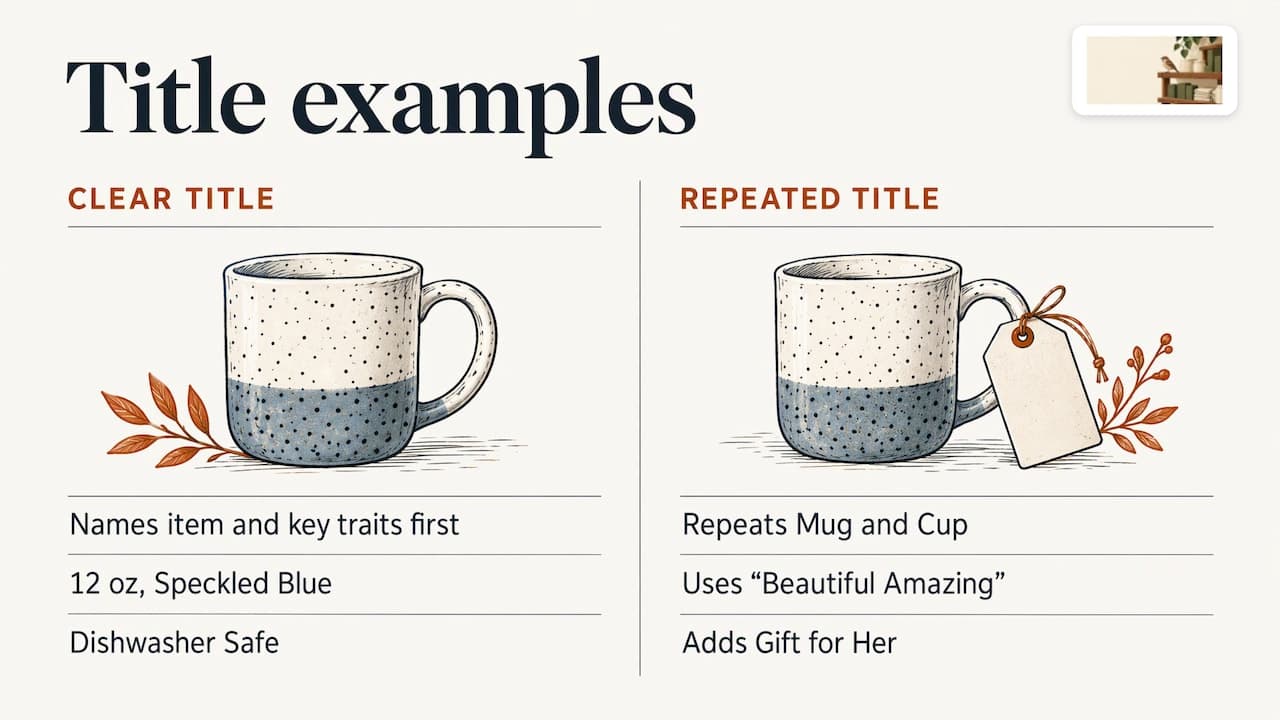
The title tells buyers and search what the item is. Etsy’s Seller Handbook advises naming the item clearly, putting its key traits first, keeping the title easy to scan, avoiding repetition and moving subjective words like “gorgeous” into the description. It also says search looks at titles, tags, attributes, descriptions, the first photo and reviews together, so a title does not need to carry every detail.
Example: “Handmade Ceramic Mug, 12 oz, Speckled Blue, Dishwasher Safe” beats “Beautiful Amazing Mug Gift for Her Coffee Lover Mug Cup”. The first says what it is. The second repeats itself.
2. Category and attributes
Attributes (also called item specifics) are the structured fields for size, color, material and similar details. eBay’s guidance says strong listings are easy to find and understand, honest, accurate and complete. Its Canadian Seller Centre recommends choosing the most relevant category and filling in recommended item specifics, and describing unique qualities and flaws clearly.
3. Product identifiers
A product identifier is a code, such as a UPC or GTIN (the barcode number), that tells a marketplace exactly which product you sell. eBay’s US guidance says the catalog match should be the exact item, because a similar but wrong version can mislead buyers and raise return requests. Google also recommends a unique, consistent product ID and GTINs where available.
4. Description, photos and variants
Descriptions should answer the questions a buyer would ask in a shop: size, material, what is included, care. Photos should be clear and show the product from more than one angle. Variants (the size and color options of one product) need consistent information across every option. Amazon’s integration guide notes that a variation parent is only a logical grouping, not a buyable product with its own price or quantity, so details belong on each child option.
5. Price, shipping and stock
Google says price and availability should be current, including tax and shipping, and that mismatches can lead to lost customers or disapproved listings. This is where small stores leak most: a sale price left on, a sold-out item still live, a shipping charge that changed.
For a deeper walk through matching details across pages, see our product detail consistency checklist.
What each marketplace rewards
| Platform | What it looks at | Source |
|---|---|---|
| Etsy | Titles, tags, attributes, descriptions, first photo, reviews, plus listing detail, photo quality and customer-service record | Etsy Seller Handbook, Etsy news |
| Walmart | Content, offer (price, shipping, in-stock rate), performance | Walmart guide |
| eBay | Accurate, complete listings with photos, item specifics and the right catalog match | eBay Seller Center |
| Google Shopping | Complete data, current price and availability, consistent IDs | Merchant Center |
Etsy is explicit about this. In August 2024 it said search now factors in listing quality, including listing detail, photo quality and customer-service track record, and it launched a Search Visibility Page with tips on image quality and quantity, return policies, message response times and shipping prices. If you sell on Etsy, check it. Our Etsy listing SEO checklist goes through ten fixes in detail.
Rules change, so listings go stale
Marketplaces keep tightening requirements, and a listing that was fine last year can fall out of line. Two examples reported in 2026:
- Amazon is reported to have introduced a 75-character title cap outside media categories and a searchable 125-character Item highlights field.
- eBay is reported to be standardizing size and condition fields for apparel, footwear and coins, with missing or non-standard values blocked or held from July 2026.
Check each marketplace’s seller pages for current rules before you edit in bulk.
Then there are the small, daily slips: a typo, a broken image, a price that no longer matches. Walmart’s guide recommends monitoring inventory, using correct UPC/GTINs, avoiding duplicate listings, managing variants and fixing unpublished items. Amazon’s older seller guidance goes further and recommends syncing inventory quantity every 15 minutes. Nobody does that by hand. If your product data lives across several systems, this overview of catalog data hygiene and order management shows where mismatches start.
A simple routine you can run yourself
- Pick your top 10 sellers by revenue.
- Check each title against the rules above.
- Open every image. Make sure none are broken or blurry.
- Compare price and stock with your real numbers.
- Confirm category, attributes and identifiers are filled in.
- Note what you changed and the date, so you can see the effect later.
On measuring: change a few things at a time, and compare views and orders over several weeks. Seasons, ads and holidays move sales too, so one good week proves little. Etsy itself saw more 4- and 5-star reviews and fewer refund requests after weighting quality in search, which it reported as evidence that quality helps shoppers.
The routine works, but it has to be repeated. That is the part most owners cannot keep up with.
Your options for getting it done
Owners have several ways to get listings checked. Here is how they compare, with prices as each provider states them.
| Option | What you get | Price |
|---|---|---|
| ShelfSparrow | Done-for-you audit of titles, SEO, typos and broken images, fixed in 72 hours; then listing checks, stock alerts and daily summaries | $297 one time, then $29/month |
| Lydia | AI store management for Shopify and Etsy, audits across 9 categories | $497 one-time audit with report in 48 hours, then $1,997/month |
| Speechify Boost | Audits products and drafts fixes (titles, copy, photos, meta) for you to approve, plus a weekly digest | See provider |
| OptraSeven | Shopify conversion-rate (CRO) agency, deep audit; aimed at brands doing $200k to $5M a year, no $29/month watch | $149 founding offer against a $297 regular price |
| Focused Developer | Shopify audit with report in 5 business days; money back if fewer than 5 fixes are found | €150 |
| Upwork and Fiverr freelancers | Mostly report-only, no monthly watch | $35 to $1,299 |
| CRO agencies | Full conversion-rate work | $1,500 to $3,000 or more |
A “CRO” agency works on conversion rate optimization: getting more of your visitors to buy. It suits larger brands. Tools such as Prediko, Sellbrite and StoreClaw are software you operate yourself. If you want a closer look at that category, we compare them in our guides to product listing management software and Sellbrite alternatives.
The difference that matters for a small store is who does the fixing. A report that lists 40 problems still leaves you with 40 problems. Speechify Boost drafts fixes for your approval. ShelfSparrow fixes issues on the spot. We are a done-for-you service, not software: no dashboard to learn.
Perspective: why we fix instead of report
Most small stores do not have a listing problem. They have a follow-through problem. The owner knows the title is clumsy and the third photo is broken. The work just never rises to the top of a busy week.
That is why we built ShelfSparrow as a service, not another dashboard. The audit covers titles, SEO, typos and broken images, and we fix them in 72 hours. After that, a steady eye on your listings: checks, stock alerts and a short daily summary. A little order, all day long.
We audit any online store or marketplace, including Shopify, Etsy, Amazon, Walmart, eBay and WooCommerce. At $297 once and $29 a month, it is priced for stores of your size.
Francis
Get your listings fixed
If you would rather not spend your evenings on this, our store audit is $297 one time. It covers titles, SEO, typos and broken images, fixed within 72 hours, with a plain-English, prioritized report. Then $29 a month gives you listing checks, stock alerts and daily summaries, so the store stays tidy. You can start at ShelfSparrow, or see the Shopify and Etsy listing audit.
More reading is collected under listing quality.
FAQ
What should I fix first on a weak listing?
Start with the title and the first photo. Then check category, item details, price and stock. These decide whether buyers find and trust the page.
Does listing quality affect search ranking?
On Etsy, yes. The company says search factors in listing detail, photo quality and customer-service record. Walmart’s guide also scores content, offer and performance.
How often should I check my listings?
Regularly, and stock and price most often, since they change daily. Our $29/month plan runs listing checks and stock alerts and sends a daily summary.
Can the same fixes work across Shopify, Etsy and Amazon?
The basics carry over: clear titles, good images, accurate details and stock. Field names and rules differ by marketplace, so each channel needs its own check. We audit any online store or marketplace.
Sources
- Tips to optimize your product data, Google Merchant Center
- Listing Quality, Walmart Marketplace
- The Anatomy of a Well-Crafted Etsy Listing, Etsy Seller Handbook
- Evolving search and discovery, Etsy news
- Create great listings, eBay Seller Centre
- Listing best practices, eBay Seller Centre Canada
- Listing best practices, eBay Seller Center US
- How To Get Started with MWS, Amazon
- Amazon Policy Tracker 2026
- The Paradise Report, June 11